
Here’s what employers need to know.
Abu Dhabi clarifies healthcare Tawteen requirements
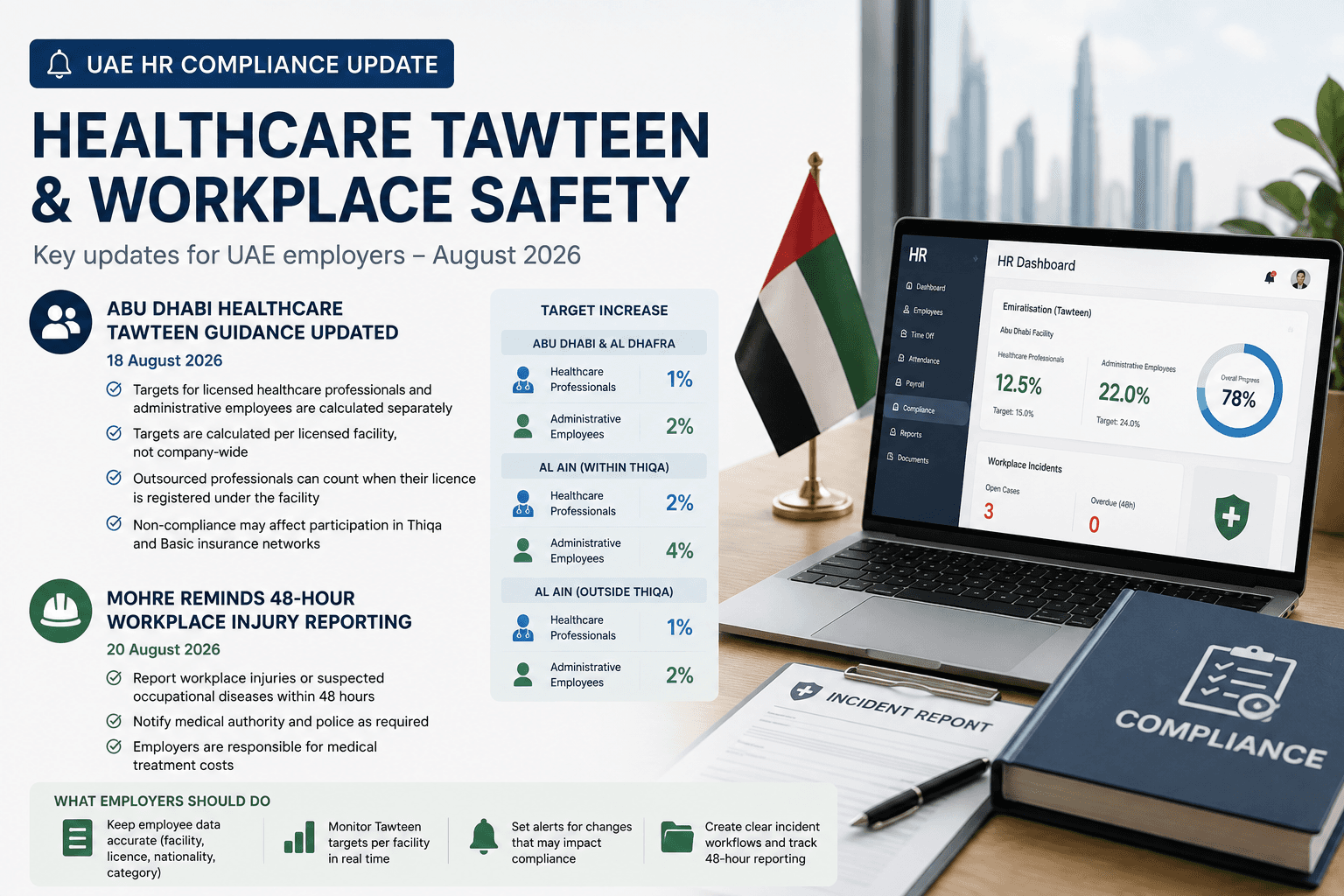
On 18 August 2026, the Department of Health – Abu Dhabi (DoH) updated its Tawteen guidance for healthcare and pharmaceutical facilities.
The underlying requirements are not new, but the guidance provides important clarification on how Emiratisation targets should be calculated.
Employers need to track licensed healthcare professionals and administrative employees separately.
For facilities in Abu Dhabi and Al Dhafra, the required increase is:
1% for licensed healthcare professionals
2% for administrative employees
For Al Ain facilities within the Thiqa network, this increases to:
2% for healthcare professionals
4% for administrative employees
Al Ain facilities outside the Thiqa network follow the 1% / 2% targets.
Importantly, targets are calculated per licensed facility, not simply across the entire company.
This means healthcare groups operating multiple clinics or facilities need to know exactly where each employee is assigned and where their professional licence is registered.
DoH also clarifies that outsourced healthcare professionals can count toward a facility's Tawteen calculation when their professional licence is registered under that facility.
Compliance may be reviewed during facility licence renewals, Thiqa contract renewals, inspections and audits.
What employers should do
Healthcare employers should ensure they can accurately track:
Nationality → Employee category → Professional licence → Facility assignment → Tawteen target
Employee changes such as hiring, resignation, transfer or licence reassignment should automatically trigger a recalculation of the facility's compliance position.
This is particularly important because DoH warns that failure to meet applicable targets may affect participation in the Thiqa and Basic insurance networks.
MOHRE reinforces 48-hour workplace injury reporting
On 20 August 2026, MOHRE also reminded private-sector employers of their obligations when workplace injuries or suspected occupational diseases occur.
This is not a new requirement, but it is an important compliance reminder.
Employers must report applicable incidents to MOHRE within a maximum of 48 hours, alongside required notifications to the relevant medical authority and police.
Employers are also responsible for applicable medical-treatment costs.
For HR teams, a workplace injury should therefore immediately trigger a structured workflow:
Incident → Medical notification → Police notification → MOHRE → Documentation → Follow-up
The 48-hour deadline should be actively tracked, with medical reports, police records, MOHRE submissions and other evidence retained for audit purposes.
HR compliance is becoming data-driven
Both updates highlight a broader direction in UAE HR compliance.
It's increasingly not enough to simply have the right policies and documents.
Employers need accurate employee data, automated calculations, structured workflows, regulatory deadlines and complete audit trails.
A resignation can change an Emiratisation percentage. A workplace accident can immediately start a 48-hour compliance deadline.
For HR teams, compliance increasingly needs to be part of everyday employee operations rather than something checked only before an audit or licence renewal.
References
Department of Health – Abu Dhabi — Tawteen Programme:
https://www.doh.gov.ae/en/programs-initiatives/tawteenMOHRE — Occupational Health and Safety Guide:
https://www.mohre.gov.ae/assets/download/11018ec0/Occupational-Health-and-Safety-Guide-EN.pdf.aspx
Compliance note: Requirements may vary according to jurisdiction, establishment type and employee circumstances. Employers should verify current requirements with the relevant UAE authority.