

Most HR teams are still spending too much time on repetitive operational work.
Answering the same questions about company policies.
Explaining leave balances and rules.
Following up on approvals.
Helping managers complete performance reviews.
Setting up attendance, overtime, or payroll policies.
Responding to employees asking, “Where can I find this?” or “How do I do that?”
These tasks are necessary, but they consume time that HR teams could spend on something much more valuable: people, culture, and growth.
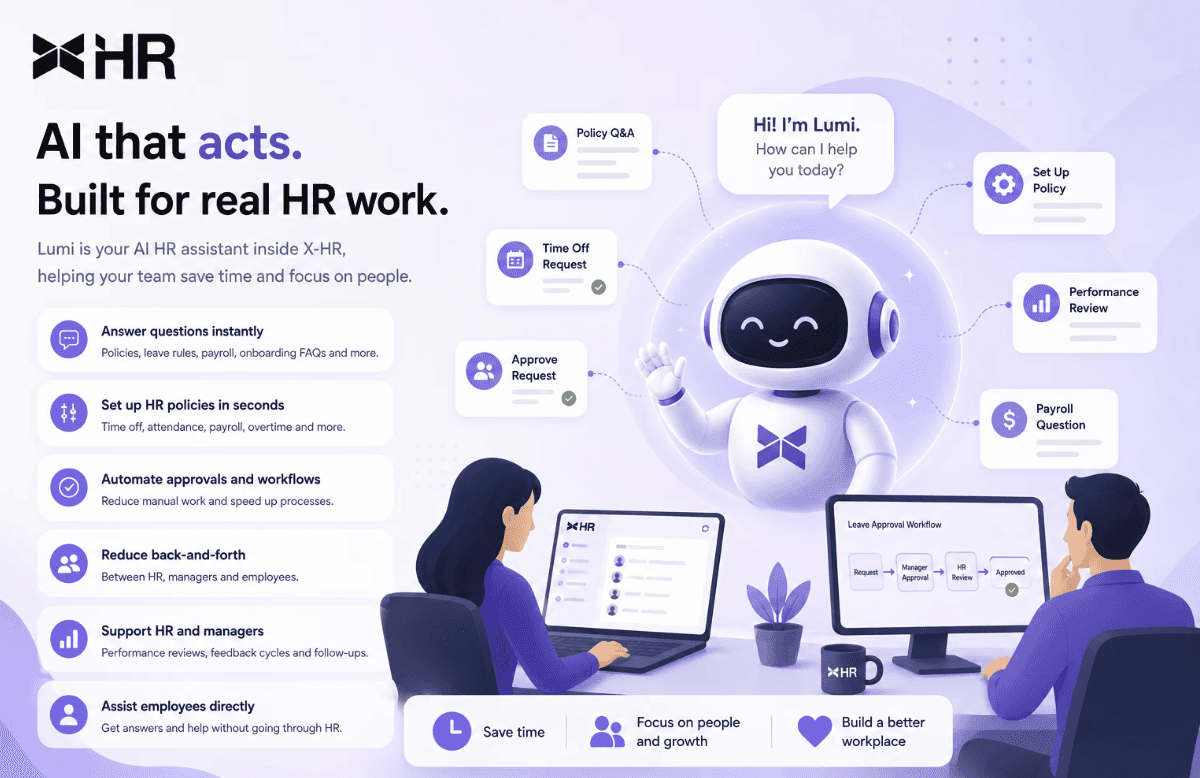
That's exactly why we built Lumi, the AI agent inside X-HR.
AI Should Solve Real HR Problems
There's a lot of discussion about bringing AI into HR.
But adding a chatbot on top of an HR system isn't enough.
AI should understand real HR use cases and help people get work done.
With Lumi, HR teams can use AI to:
Answer questions about company policies, leave rules, payroll, onboarding, and other internal information.
Set up complex HR policies such as time off, attendance, payroll, and overtime in seconds.
Automate approvals and workflows.
Reduce manual back-and-forth between HR, managers, and employees.
Assist HR and managers with performance reviews, feedback cycles, and employee follow-ups.
Help employees directly instead of routing every question or request through HR.
The goal isn't to introduce another tool that HR teams need to learn and manage.
The goal is to remove work.
From Questions to Actions
We believe one of the biggest differences between traditional AI assistants and the next generation of business software is the ability to take action.
Imagine an employee saying:
“I want to take next Friday off.”
The AI shouldn't simply explain the company's leave policy.
It should understand the policy, check the employee's balance, consider the relevant rules, create the leave request, and send it through the correct approval workflow.
Or an HR manager could say:
“Create an overtime policy with a maximum of two hours per day and send anything above that to the manager for approval.”
Instead of explaining how to configure it, the AI should help configure it.
That's the direction we're taking with Lumi.
AI Should Adapt to HR
AI shouldn't force HR teams to change how they work just because AI is the latest technology.
It should understand how the organization already operates — its policies, permissions, workflows, employees, managers, and organizational structure.
Then it should help automate the inefficient parts.
The technology should disappear into the workflow.
HR teams shouldn't need to think:
“How do I use AI for this?”
They should simply describe what they want to accomplish.
Giving HR More Time for People
The purpose of AI in HR isn't to replace the human side of HR.
It's almost the opposite.
By removing repetitive administrative work, AI can give HR teams more time for the things where human judgment and relationships matter most.
Supporting employees.
Building culture.
Developing talent.
Helping managers become better leaders.
Growing the organization.
That's the future we're building toward with Lumi and X-HR.
AI should follow real HR use cases.
AI should remove manual and inefficient work.
And most importantly:
AI should act, not just chat.


